Trading Meme Coins With a $10 Portfolio
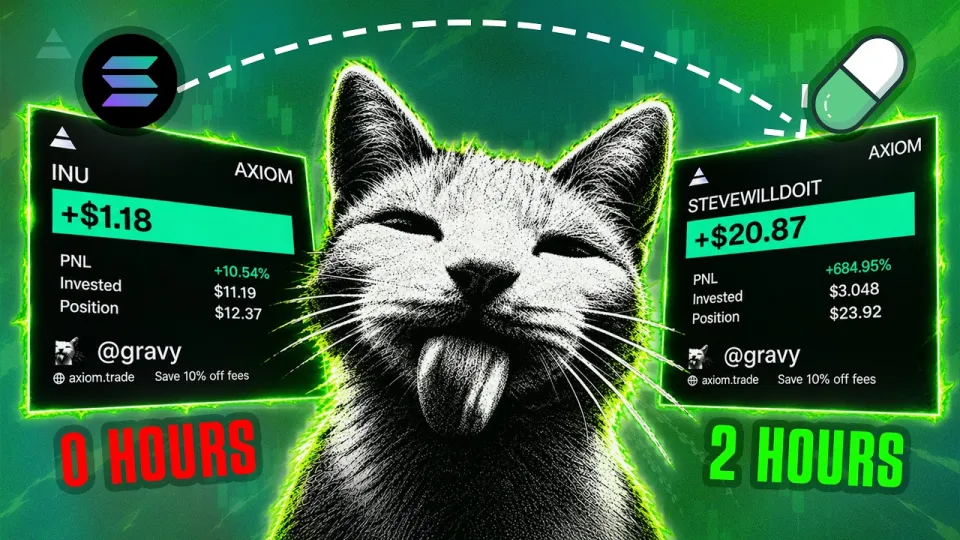
Video: I Tried Trading Memecoins with Just $10
Want articles like this for your own video to promote it on YouTube and Google? Order them through the Telegram bot @sat_sit_bot. The bot writes and publishes the articles itself (with your YouTube video embedded) on popular topical websites (no ads). Free trial — 50 articles.
· based on the channel gravy
Meme coin trading with $10 is possible, but only if you treat fees, slippage and position size as the strategy itself rather than an afterthought. A $10 bankroll can survive several trades on Solana, yet each buy and sell eats a fixed slice of a tiny balance, so the coin you pick matters less than how you enter and exit. The experiment on the «gravy» channel, which traded five meme coins with buys capped at 0.05 SOL through Axiom, shows exactly where a small portfolio wins and where it bleeds.
What $10 actually buys on Solana
A $10 balance is not a handicap in itself; the handicap is the ratio between fixed costs and position size. On Solana, a swap costs a network fee plus a platform fee plus priority fee, and on top of that comes slippage — the gap between the price you see and the price you get. With a 0.05 SOL buy, even a modest 1% platform fee and 1–2% slippage removes a visible chunk of your starting capital before the chart moves at all.
That is why the channel's rule of capping every buy at 0.05 SOL matters. It keeps each position small enough that a total loss does not end the session, and it forces you to plan the exit before entry. If you want to replicate the setup, the workflow looks like this:
- Fund a Solana wallet with a small amount you are willing to lose entirely.
- Connect it to a trading terminal such as Axiom, which aggregates liquidity and shows fees before you confirm.
- Cap each buy at a fixed size — in the experiment, 0.05 SOL per trade.
- Decide your exit in advance: a fixed percentage target or a hard stop, not a feeling.
- Track every trade, including the losers, because five trades is a sample, not a track record.
A $10 portfolio cannot average down meaningfully. If a coin drops 40% after your buy, adding to the position doubles your exposure for a fraction of the upside you would get with a larger account. Small balances should be treated as one-shot attempts, not as a scaling game.
The five trades: STEVEWILLDOIT, NPC, MET, PUMPY and UNTXD
The experiment ran five trades, and the tickers are the useful part because they show the type of coin a small account can realistically catch. The first was STEVEWILLDOIT, a coin built on the «Steve will do it» internet meme format — the kind of name that spreads through short clips and reply guys rather than through a whitepaper. The second was NPC, another meme-native ticker riding the «NPC» internet archetype.
The third was MET, tied to Meteora, a Solana liquidity protocol. That is a different category: a coin whose narrative leans on a real product and a real community rather than pure meme energy. The fourth was PUMPY the Trader, a character-style meme coin. The fifth was UNTXD, which the creator describes as the one he fumbled — a reminder that even a planned process breaks down when execution slips.
The pattern across all five is consistent with how Solana meme coins behave: a launch on a platform like pump.fun, a fast run driven by social attention, then a fade as early buyers exit. A $10 trader cannot front-run that cycle, but can participate in the middle of it if the entry is early enough and the exit is mechanical.
Why narrative coins like the X Money meta run
Narrative is the only durable edge in meme coins, because there is no earnings or cash flow to value. The channel uses the X Money coin meta to illustrate this: a ticker gains traction when it attaches to a story people already care about — in that case the idea of payments inside X, amplified by the e/acc and Cream crowd. When influential accounts repeat the same story, the coin becomes a proxy for a belief rather than a business.
That has three practical consequences for a small account:
- Speed beats analysis. By the time a narrative is explainable in one sentence to a stranger, the early move has usually happened.
- Attention is finite. Narratives rotate. A coin tied to a story that is losing headlines loses buyers faster than it gained them.
- Community quality matters. A ticker with active holders and consistent posting survives the first dump; a ticker with only a name does not.
A common frustration among viewers is exactly this: finding a coin with a good narrative and still losing money because the dip never recovers, or selling at a 20–40% loss and watching the coin run later. The fix is not better prediction but a written rule — for example, exit half at a target and let the rest run with a stop at breakeven — applied before the trade, not after the loss.
Position sizing and fee math for a tiny balance
Fees are the silent tax on small-portfolio meme coin trading, and they compound across trades. Every round trip includes the network fee, the platform fee, priority fees for faster inclusion and slippage on both sides. On a 0.05 SOL position, a 2% platform fee plus 2% slippage on entry and exit can consume roughly 8% of the position before the price has done anything.
That changes the math of what a «win» is. If your average round trip costs about 8%, a 20% gain nets closer to 12%, and a 20% loss costs closer to 28%. With five trades, two clean winners and three small losers can still leave you roughly flat — which is why the creator's own audience asked for the total PnL, the number that actually answers whether the experiment worked.
Practical rules that follow from the math:
- Never size a trade so that fees exceed your expected edge; on $10, that means skipping low-conviction setups entirely.
- Prefer terminals with transparent fee display and cashback — the Axiom referral advertises 2x cashback and 15% lower fees, which directly reduces the drag.
- Avoid chasing a coin after a vertical candle; slippage on entry is worst exactly when the chart looks best.
- Take partial profits rather than waiting for a round number; on a small position, one clean exit beats a hopeful hold.
Common questions from small-account traders
The most frequent doubts around low-balance meme coin trading are about consistency, information overload and whether the whole exercise is worth it. Finding coins with good narratives feels overwhelming because it requires reading X feeds, remembering who has influence in a community and tracking which stories are heating up. The realistic answer is to narrow the funnel: follow a small set of accounts that consistently surface early narratives, use one terminal that shows new pairs and volume, and accept that you will miss most coins.
The second recurring doubt is whether $10 can produce anything meaningful. It cannot produce income, but it can produce data — a documented record of entries, exits and mistakes that costs very little to acquire. Treat the first small portfolio as tuition, and only increase size once your own log shows a repeatable process rather than a lucky week.
The third is tooling. A clean X feed is a real edge: mute hype accounts, follow builders and traders who post reasoning rather than tickers, and keep a separate list for launch platforms. Security hygiene matters too — use a dedicated wallet for meme coins, never connect your main holdings, and be careful with free VPN or browser extensions that can expose your activity.
Useful links
- Axiom trading terminal with the creator's referral (2x cashback, 15% lower fees): https://axiom.trade/@gravy
- The Trenches Discord: https://discord.gg/W7TqkExcSd
- Discord with free Axiom imports and trade signals (not financial advice): https://discord.gg/9W5j3XUgYB
- Creator's X profile: https://x.com/gravyski
- Leverage trading with a 20% futures fee reduction: https://www.bitbase.com/landing-page/trading-earning-Gra?ref=8CYOGY
Bottom line
Trading meme coins with $10 is feasible on Solana, but the experiment is a lesson in cost control rather than a path to profit. Five trades capped at 0.05 SOL each show that narrative selection gets you into the right coins and mechanical exits get you out, while fees and slippage decide whether the result is positive. The channel «gravy» is honest about the fumbled trade, which is more useful than a highlight reel. If you want to try the same setup, start through Axiom with the referral, log every trade, and judge the experiment on total PnL rather than on the best single winner.
Key takeaways
- Five real Solana meme coin trades, each buy capped at 0.05 SOL — roughly $10 at SOL prices around $200.
- Tickers covered: STEVEWILLDOIT, NPC, MET (Meteora), PUMPY the Trader and UNTXD.
- The X Money meta (e/acc, Cream) is used to explain why narrative coins run and fade.
- Axiom's referral offer is advertised as 2x cashback and 15% lower fees.
- Fees and slippage are the main reason small balances underperform — not the size of the bet itself.
Questions & answers
Can you really trade meme coins with only $10?
Yes, technically — a $10 balance covers several 0.05 SOL buys on Solana. The constraint is cost drag: network, platform and priority fees plus slippage can eat close to 8% of a small position on a round trip, so only high-conviction setups are worth taking.
How do you pick meme coins with a good narrative without getting overwhelmed?
Narrow the funnel instead of watching everything. Follow a small set of accounts that surface early stories, use one terminal to track new pairs and volume, and skip any coin whose narrative you cannot explain in one sentence. Missing most launches is normal and expected.
Why do I lose money even when the narrative looks right?
Usually because the entry comes after the move and the exit comes after the drop. Decide a target and a stop before buying, take partial profits instead of waiting for a round number, and accept that some coins will run after you sell — that is a cost of having rules.
What fees should a small portfolio watch on Solana meme coin trades?
Four items: the network fee, the platform or terminal fee, the priority fee for faster inclusion, and slippage on entry and exit. Referral programs such as the Axiom offer of 2x cashback and 15% lower fees reduce the drag but do not remove it.
Source: I Tried Trading Memecoins with Just $10 · Markdown version